Tuesday, January 29, 2008
Dealing with Eskom's load shedding
2 comments
:
Tags:
energy efficiency
,
eskom
,
load shedding
,
south africa
 Load shedding and Eskom have been on the lips of many South Africans over the past few weeks. We have had some of our worst electrical outages ever — even to the point of mines being forced to close. We are in the middle of an energy crisis and fortunately everyone has now realised that.
On Friday the government released a plan to deal with this crisis, along with a background document explaining the current situation, and some more details of the plan.
The problem is that there has been a rapid growth in demand and the reserve capacity has been consumed, leaving Eskom with only about 8–10% reserve margin. They want to have 15% reserve margin. The current small margin puts a lot of physical strain on the grid as it reduces time for maintenance (generators have to run more), and results in the generators running harder (like driving your car close to the red line the whole time). These stresses result in more unplanned outages.
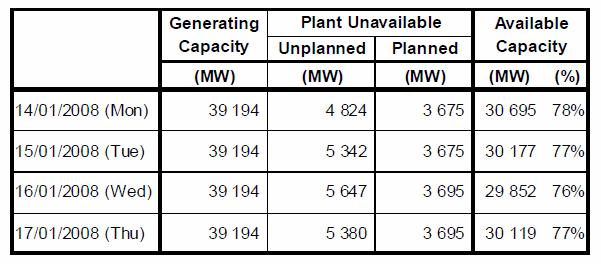
For example, in the week of 14 January a total of 8700MW (22%) of the capacity was unavailable. 5000MW of that was due to unplanned outages.
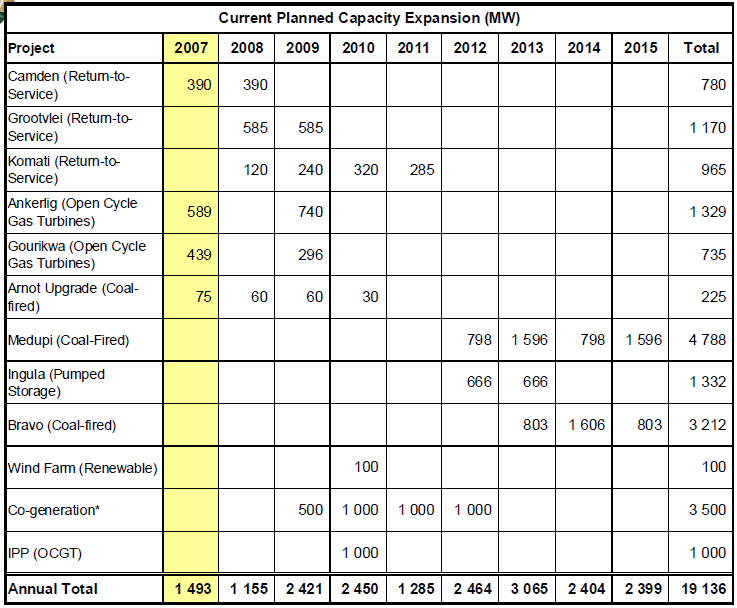
In the medium and long term Eskom is continuing to expand their capacity, but in the short term drastic measures need to be taken to keep the economy supplied with electricity. Right now Eskom needs to release about 3000MW of capacity to provide enough "breathing room." That is a large chunk of power....although you might be surprised at how easily it can be obtained.
There is a single viable option to solve this crisis in the short term, and that is power conservation. The government and Eskom have identified this and have the following short term goals (my comments below the bulleted lists):
- Introduction of a quota system (rationing) based on success in Brazil
- Consumption reduction targets for
- Industial: 10%
- Commercial: 15%
- Hotels, resorts, shopping centres, conference centres: 20%
- Large offices, government buildings: 15%
- Agriculture: 5%
- Residential: 10%
- Penalty tariffs for use above quotas
- Cut–off of repeat offenders
- Incentives for exceeding savings targets
- Trading of used quotas for large consumers
Brazil's system was pretty simple: all users had to reduce their consumption to 80% of their previous year's consumption. There were penalties for not complying, and incentives for exceeding the targets. Large consumers could trade their excess savings. Interestingly, Brazil's greatest savings came from the low end of the market.
The key to making this work would be to implement the simplest practical system, and stick to it.
I think that it is a reasonable proposal, and could have the fastest impact, as there would be direct cost implications for all users, which would inspire energy savings and efficiency. - Consumption reduction targets for
- Efficient lighting roll–out programme (target 750MW by 2010)
- CFL roll–out to users
- Immediate restriction on sale of incandescent light bulbs
There is an estimated immediate savings of 600MW if all residential households change to CFLs. I think energy efficient lighting is great, but residential users are typically only using lighting at night, so this does not really play a role during the day. I believe that if businesses focus on improving their lighting efficiency it could make a significant contribution towards the targets.
It is also interesting that there are plans to back up the drive for energy efficient lighting with a restriction on incandescent lighting. 20 lumens per watt will be the minimum lighting efficiency allowed. CFLs and quartz halogen bulbs are both more efficient than this (examples of lighting efficiencies). For those of you concerned about mercury, there is a plan to develop a disposal protocol for the CFLs. - Solar water heating programme (target 650MW)
- 1 million installations over three years
- Unit cost and production capacity are issues
The high cost and slow pay–off of solar heating make it unappealing as a retrofit for residential users. Industrial users probably stand to win the most by changing over, and the next point definitely has merits. - National housing specification
- Mandate all new houses be built with solar geyser or gas geyser
- Time switch or interlocker between geyser and stove
- Ceiling insulation
- Geyser insulation
- Double glazing
- Weather stripping of doors and windows
The actual impact of this will take a while to materialise, but the benefits will be reaped for years to come. Interlocker switches will ensure that geysers and stoves do not operate concurrently, reducing the peak demand in the mornings and evenings. Improvements in insulation will reduce the need for heating and cooling, which is a benefit to the national grid, as well as the user.
Overall, I think the approach is correct, but the reality is that the power still lies in our hands. That is a great responsibility for each of us. If we want to see our country grow (and our mines working again!) we need to each take responsibility for reducing our energy consumption as much as possible. We (and the government) need to take immediate action to resolve this problem.
I believe that the government and Eskom should embark on a huge national advertising campaign to support this plan. It should be hard hitting and demonstrate that each of us has a role to play in securing our future. It should become socially unacceptable to use power inefficiently. We each need to stand up for our own future.
To find out how to help read the 7 best ways to stop load shedding.

Monday, October 15, 2007
A better life — right now
2 comments
:
Tags:
environment
 I found out that today is Blog Action Day while reading through my feeds this morning — I've clearly been sleeping. So my small contribution for today is to try to amplify a simple and important message.
For a while I had been struggling with the whole message of global warming and climate change. The main reason was that the story was weak (in my opinion at least). Now what I mean by weak is that it was not changing enough lives — not creating enough action. I think Seth Godin managed to express the problem best.
The next step was figuring out the solution, which proved to be difficult. Thankfully I came across what I consider to be the best environmental blog I know of, No Impact Man, and in particular, this post.
"My point is that a big boost to the environmental cause might come with spending a little less time making people scared of a worse life and a little more time inspiring them towards a better one"Let us each start working towards a better life right now. We need to realise that the impact of our lifestyle is an event which is taking place now. We have real and immediate problems that need to be addressed, from children suffering from asthma due to exhaust fumes, to the depletion of fish stocks off the West coast of South Africa.
Take action to make a better world for yourself — right now.
Bonus Links:
- The City of Cape Town (my home - thanks to my wife for the photo above) published the "Smart Living Handbook" which has some excellent info and ideas.
- Lawn care for the cheap and lazy (I use these techniques on my own lawn).
- Gardening with indigenous South African plants.
Technorati tags : environment
Sunday, October 07, 2007
It's fill packaging, just better
1 comment
:
Tags:
environment
,
recycling
,
waste

I recently received some samples from Texas Instruments and was pleasantly surprised — actually blown away — by their fill packaging. Blown away by fill packaging? Let me explain...
Most of the fill packaging I have seen before normally involved polystyrene "chips" — basically plastic. What happens to those polystyrene chips normally? Well, expanded polystyrene is considered uneconomical to recycle[1] (in South Africa at least[2]) and ends up in landfills (or strewn around the countryside, waterways, etc.)
So I take out my samples and they are wrapped in paper — not just any paper, but a special expanded paper. Lucky for me, the manufacturer was smart enough to put their website onto the packaging: www.geami.com.
 Go check it out. It is paper with little slits cut into it. The slits cause the paper to expand when removed from the roll. This is a really great way to avoid bubble wrap, polystyrene chips, and other plastic packaging. They have some videos and cost comparisons that are worth checking out. If TI is using them for the free samples they ship all over the world (and most likely everything that they ship), then that alone must imply that this packaging is a good and viable option.
Other than the direct advantages of the Geami packaging, it can also be transported in its unexpanded form, which reduces the toll that transportation has on the environment.
The beauty of this product is that it is a simple and elegant packaging solution that is easily recyclable and improves not just the environmental friendliness of the packaging, but ALSO reduces the cost. A great example of engineering simplicity.
There are some other alternatives to polystyrene which are similar, but made from biodegradable compounds. It is hard to compare these with polystyrene because I do not know enough about them, but there are a couple of questions that come to mind (if anyone can answer these for me, please do):
- How do these products compare on cost?
- What is the impact of bioplastics on food prices? (I believe this is a big issue with biofuels and bioplastics)
- How recyclable are they? (recycling is generally better than allowing them to degrade in landfills)
[1]From The Plastics Federation of South Africa (scroll to the part about "The Plastics Recyling Sequence" and find polystyrene),
"The polystyrene mostly seen is the white, very light, friable, expanded or foamed polystyrene (PS-E). Although this material is recyclable it has such a large volume to mass ratio that it is completely uneconomical to transport and recycle at present."Also see polystyrene recycling on Isolite's website.
[2]Notice how expanded polystyrene products are absent from the list of recyclables for Cape Town, and on the non–recyclable side for Johannesburg.
Technorati tags : environment, recycling, waste, packaging, paper
Tuesday, June 05, 2007
The "right" processes are wrong
2 comments
:
Tags:
business
,
processes
,
systems
 I was pondering processes while making some tea today. Most of my process pondering these days is inspired by what Sig is doing.
I think our natural tendency is to work hard toward some perfect process. We try doing something in one way, find the flaws, adjust, grow, etc. Hopefully as things progress we have developed processes that work really well for us. But that is the key right there, they work well for us. The question we need to ask is whether they work well for anyone else.
Think about an employee trying to get a job done. What usually happens is that the boss (we) try to impose our process onto their actions. It is a kind of FIFO mentality (fit in or f-off). Our process might work brilliantly for us, but horribly for them.
Compare it to making a cup of tea (or coffee, or your beverage of choice) — every person has subtleties and nuances in the way they make their favourite drink. The end result is the same, a drink which you enjoy drinking, the process is different. Typically we are happy to allow people their own coffee/tea/beverage making process, why do we expect them to design/code/file/etc. according to ours? Do we allow freedom for variation in the process if the end result is the same?
It seems like a fixed process way of working is a relic of modernism. Allowing processes to vary provides flexibility to create efficiency (each person works differently, just like we each make tea differently). Also, we get to watch the process and see the benefits (and disadvantages) of how others do things. Again, adjust, grow, etc.
On the other hand we also want to avoid the confusion of a laissez–faire environment. There must be some form of regulation. Do not police process, regulate it. Ensure outcomes, monitor efficiency. Be open to new ideas. Adjust, grow etc.
When I was preparing this post I sent it to a friend, Dave Alcock (founder of The Forum SA), who gave me some great feedback which I felt needed to be published as is:
"There are times when the concept needs to take a back seat. Particularly where team members interface — there need to be agreed conventions of handover and interaction at those interfaces IMHO.
"It also relies on there being adequate skill/experience/ability within the people you give this licence to. Some people simply need method otherwise there is no way they can achieve the objective.
"My personal take: Method can turn ordinary people into super-achievers and turn super-achievers into ordinary people."
Technorati tags : processes, business, systems
Tuesday, May 15, 2007
Some lights are more equal than others
The short version (my "elevator pitch"):
 Compact fluorescent lamps (CFLs) use about a fifth of the energy of a normal (incandescent) bulb to produce the same amount of light, so switching to CFLs means more money in your pocket every month (lower energy bills). Even though they are more expensive to purchase, the upfront cost of a CFL is recovered within six to twelve months (depending on the price of your electricity). Incandescent bulbs only last for about eight months, while CFLs can last for up to 4 years or longer, which is an extra saving (fewer bulb replacements).
A lot of people say they do not like CFLs because the light is not nice, they flicker, and take time to warm–up. With the new CFLs all of these problems have been solved. They have quick start–up times, no flicker and good light quality. Make sure you choose a light marked "warm white" if you prefer the yellower colour of incandescents. CFL quality can vary quite a bit so buy a good quality bulb like the Philips Genie or Osram Dulux SuperStar.
The long version:
 I am really passionate about energy conservation for a couple of reasons (which I'll talk about another time — one of the big ones is that it pays). So when I see people inventing technologies which I think will drive people away from good and practical ways of saving energy, something has to be done.
One of those bad ideas is the BC3 bulb which Dan Lockton's posted about on his blog. It forces people to choose expensive and difficult to find CFLs instead of just allowing them to choose what is best for them (see my comments on Dan's blog).
Education, I believe, is the key to the solution, not controlling people's behaviour. As soon as you understand the huge benefits of CFLs the choice becomes easy.
I was having a conversation recently where I was explaining my passion for energy saving and I was using the example of compact fluorescent lights as a simple energy saving solution that is not generally used. The guy I was chatting to gave me the answer that I expect a lot of people would, "When they can make a CFL which gives the same light as a normal light bulb I'll change."
You probably feel the same way, the first picture that comes to your mind when you think of a CFL is a dimly lit room, and a light that takes a few minutes to get to "full power." Think again.
I believe that there are two critical issues which keep people away from using energy efficient light bulbs — light quality and initial cost.
Unfortunately a bulbs ability to illuminate can not simple be measured by the wattage of the bulb. Firstly, CFLs have a higher efficiency than incandescents i.e. they are better at converting electrical energy into light — that means more light and less heat.
The more confusing thing is that not all light is equal. Light has two important properties: a colour temperature, and its ability to render colour accurately. Basically "warm" light (below 3200k) is yellower, and "cold" light (above 4000k) is bluer. Colour rendering index (CRI) is a measure of colour variation when compared to a reference (for a nice summary I found this on Osram Sylvania, and this on LightSearch). Incandescents typically produce warm white light and have a near perfect CRI, while CFLs are often cool white and have lower CRIs. Many new CFLs do have warm white light and higher CRIs, and the light they produce is comparable to incandescents.
I have yet to see a CFL that is marked with the CRI, so when you are standing in a store the best thing to look out for is the light colour which should be marked on the packaging (normally it will say "warm white" or "cool white" — if this is missing then the light is probably cool white). Also, buy a better CFL rather than the cheapest one.
The higher quality CFLs, like the Philips Genie or Osram Dulux SuperStar, are more expensive, but you can expect to get a longer lifetime, as well as a higher quality light — including flicker free start–up and short warm–up times. The price difference is really insignificant when you look at the lifetime of the bulbs.
So how much do you save, and how quickly do you recover the costs of the bulb? This varies from country to country depending on the price of electricity, as well as the price of the bulbs. Obviously the higher the cost of your electricity the faster you will recover the costs of the bulb and start saving.
South Africa happens to have some of the cheapest electricity in the world at about 0.43ZAR/kWh (kilowatt hour), but even for us the extra cost of the bulb is quickly recovered. In fact, if your light is on for 3 hours a day, and you replace a 100W incandescent with a 18W CFL, it only takes about 7 months to recover the initial costs, and you still have 60 months of savings to go (for a 6000hr lifetime bulb).
I have set up a little spreadsheet that you can use to calculate the savings (let me know if you spot any errors). I think that switching to energy saving technologies makes so much economic sense that I even sent a "Tip for Trevor".
The conclusion
You can put money back into your pocket, AND have good light — what more needs to be said? It is definitely worth trying out one of the new CFLs. Start today.
For lots of information about light, and lighting have a look at LightSearch's light guides.
[Update] I came across this on Digg, 10 things worth knowing about CFLs.
[Update] Just a quick comment on the burden on the planet (which Arash mentioned). I am trying to avoid making energy savings about reducing carbon emissions for a couple of reasons, mainly that I am not particularly convinced that this argument is going to change a lot of people's actions. Seth has some things to say about More or Less. There are some more compelling (and also more frightening) reasons to act other than carbon emissions reductions. More to come on this, but for now have a look at this.
Technorati tags : cfl, compact fluorescent, energy efficiency, incandescent, lighting. Trackback
Read More
 Compact fluorescent lamps (CFLs) use about a fifth of the energy of a normal (incandescent) bulb to produce the same amount of light, so switching to CFLs means more money in your pocket every month (lower energy bills). Even though they are more expensive to purchase, the upfront cost of a CFL is recovered within six to twelve months (depending on the price of your electricity). Incandescent bulbs only last for about eight months, while CFLs can last for up to 4 years or longer, which is an extra saving (fewer bulb replacements).
A lot of people say they do not like CFLs because the light is not nice, they flicker, and take time to warm–up. With the new CFLs all of these problems have been solved. They have quick start–up times, no flicker and good light quality. Make sure you choose a light marked "warm white" if you prefer the yellower colour of incandescents. CFL quality can vary quite a bit so buy a good quality bulb like the Philips Genie or Osram Dulux SuperStar.
The long version:
 I am really passionate about energy conservation for a couple of reasons (which I'll talk about another time — one of the big ones is that it pays). So when I see people inventing technologies which I think will drive people away from good and practical ways of saving energy, something has to be done.
One of those bad ideas is the BC3 bulb which Dan Lockton's posted about on his blog. It forces people to choose expensive and difficult to find CFLs instead of just allowing them to choose what is best for them (see my comments on Dan's blog).
Education, I believe, is the key to the solution, not controlling people's behaviour. As soon as you understand the huge benefits of CFLs the choice becomes easy.
I was having a conversation recently where I was explaining my passion for energy saving and I was using the example of compact fluorescent lights as a simple energy saving solution that is not generally used. The guy I was chatting to gave me the answer that I expect a lot of people would, "When they can make a CFL which gives the same light as a normal light bulb I'll change."
You probably feel the same way, the first picture that comes to your mind when you think of a CFL is a dimly lit room, and a light that takes a few minutes to get to "full power." Think again.
I believe that there are two critical issues which keep people away from using energy efficient light bulbs — light quality and initial cost.
Unfortunately a bulbs ability to illuminate can not simple be measured by the wattage of the bulb. Firstly, CFLs have a higher efficiency than incandescents i.e. they are better at converting electrical energy into light — that means more light and less heat.
The more confusing thing is that not all light is equal. Light has two important properties: a colour temperature, and its ability to render colour accurately. Basically "warm" light (below 3200k) is yellower, and "cold" light (above 4000k) is bluer. Colour rendering index (CRI) is a measure of colour variation when compared to a reference (for a nice summary I found this on Osram Sylvania, and this on LightSearch). Incandescents typically produce warm white light and have a near perfect CRI, while CFLs are often cool white and have lower CRIs. Many new CFLs do have warm white light and higher CRIs, and the light they produce is comparable to incandescents.
I have yet to see a CFL that is marked with the CRI, so when you are standing in a store the best thing to look out for is the light colour which should be marked on the packaging (normally it will say "warm white" or "cool white" — if this is missing then the light is probably cool white). Also, buy a better CFL rather than the cheapest one.
The higher quality CFLs, like the Philips Genie or Osram Dulux SuperStar, are more expensive, but you can expect to get a longer lifetime, as well as a higher quality light — including flicker free start–up and short warm–up times. The price difference is really insignificant when you look at the lifetime of the bulbs.
So how much do you save, and how quickly do you recover the costs of the bulb? This varies from country to country depending on the price of electricity, as well as the price of the bulbs. Obviously the higher the cost of your electricity the faster you will recover the costs of the bulb and start saving.
South Africa happens to have some of the cheapest electricity in the world at about 0.43ZAR/kWh (kilowatt hour), but even for us the extra cost of the bulb is quickly recovered. In fact, if your light is on for 3 hours a day, and you replace a 100W incandescent with a 18W CFL, it only takes about 7 months to recover the initial costs, and you still have 60 months of savings to go (for a 6000hr lifetime bulb).
I have set up a little spreadsheet that you can use to calculate the savings (let me know if you spot any errors). I think that switching to energy saving technologies makes so much economic sense that I even sent a "Tip for Trevor".
The conclusion
You can put money back into your pocket, AND have good light — what more needs to be said? It is definitely worth trying out one of the new CFLs. Start today.
For lots of information about light, and lighting have a look at LightSearch's light guides.
[Update] I came across this on Digg, 10 things worth knowing about CFLs.
[Update] Just a quick comment on the burden on the planet (which Arash mentioned). I am trying to avoid making energy savings about reducing carbon emissions for a couple of reasons, mainly that I am not particularly convinced that this argument is going to change a lot of people's actions. Seth has some things to say about More or Less. There are some more compelling (and also more frightening) reasons to act other than carbon emissions reductions. More to come on this, but for now have a look at this.
Technorati tags : cfl, compact fluorescent, energy efficiency, incandescent, lighting. Trackback
Subscribe to:
Posts
(
Atom
)
Subscribe

About this blog

I'm Duncan Drennan and this blog is about spreading ideas regarding engineering, our environment and creating a better world. You can also follow me on Google Reader.
Popular Posts
-
 We are in the middle of an energy crisis and each of us need to make some dramatic changes to ensure that we have electricity, and that the ...
 -
 As engineers we spend a lot of time solving problems. A customer has a problem and it needs to be fixed. The electronic boards you have just...
 -
 eWaste is a particularly difficult issue to deal with as it contains many different materials and lots of extremely hazardous substances. I...
 -
 The short version (my "elevator pitch"): Compact fluorescent lamps (CFLs) use about a fifth of the energy of a normal (incandescen...
 -
 With 48 post over nearly three years, I am certainly not a prolific blog writer. My goal has never been to write a lot, but to rather explor...
 -
 I am an advocate of making sure that every device consumes as little power as possible at all times. Indicator lights should be off, process...
 -
 Electronic design automation tools like OrCAD , PADS and Altium Designer are part of an electronic engineer's day–to–day life. We need...
 -
 Mercury in compact fluorescent tubes (CFLs) is a health hazard and therefore we should not use CFLs....at least that is the false message b...
 -
 I think that it is worth trying to understand some of the reasons we are heading towards a food crisis . The result of all of this deregulat...
 -
So here we are, the first blog post...well, really, here I am. My name is Duncan Drennan and this is my blog on business, design, electronic...