Tuesday, January 27, 2009
eWaste recycling in South Africa
Tags:
electronics
,
recycling
,
south africa
,
waste
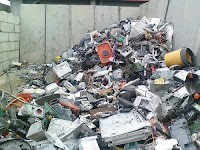
eWASA, the eWaste Association of South Africa, is an organisation concerned with the handling of eWaste and represents the various industry stakeholders (like eWaste recyclers and disposers). Their website provides useful information about where to recycle your eWaste and how the eWaste recycling process works. They also have a really fascinating (and distrubing) list of hazardous substances and what items those substances are contained in. I recommend that everybody read that list (compulsory reading for engineers and product developers).
Refurbishing, reuse and extending the life–cycle of electronic products is an important (and preferable) way to reduce eWaste and the hazards associated with recycling and disposing of these products.
eWaste recycling is expensive and the costs are not necessarily covered by the resale of recovered materials. eWASA would like to introduce an advanced recycling fee (ARF) for products which will eventually become a part of the eWaste stream. This fee will be collected by the supplier at the time of sale and used to fund end–of–life recyling. Exactly how the ARF will be collected and distributed is not yet clear. Will certain items, such as CRTs, attract a higher ARF due to greater recycling costs? We will have to wait and see.
South Africa currently has no legal framework which deals specifically with eWaste, and unlike the EU's RoHS directive, we have no laws to govern the materials used in the products that we make. I have been quite surprised in my dealings with manufacturers of printed circuit boards and assembly houses that they even still offer leaded products (because people are still using them). There are many benefits in removing these hazardous substances from your product and any issues with the alternative lead–free options have already been resolved. It is our responsibility as designers to remove these substances from our products. South Africa should introduce legislation to govern the use of hazardous materials so that we can avoid future health crises.
We need more people to be aware of, and start recycling eWaste. Fortunately Makro and Fujitsu–Siemens have partnered together with an eWaste recycler, Desco Electronic Recyclers, and begun providing eWaste collection bins in some of their stores. This will help to create awareness of how to correctly handle and recycle eWaste. eWASA's website has a full list of eWaste collection points in South Africa.
Please design and recycle wisely – it is good for you, me, and our environment.
Photo courtesty of Stephen Bullivant, licensed under a creative commons license.

14 comments :
If you are leaving a comment with your Name and URL then make sure you put http:// in front of your URL for a correct link. You can use some HTML tags such as <a>, <b> and <i> in your comment. Thanks for your message - I appreciate it :)
Note: only a member of this blog may post a comment.
Subscribe to:
Post Comments
(
Atom
)
Subscribe

About this blog

I'm Duncan Drennan and this blog is about spreading ideas regarding engineering, our environment and creating a better world. You can also follow me on Google Reader.
Popular Posts
-
 We are in the middle of an energy crisis and each of us need to make some dramatic changes to ensure that we have electricity, and that the ...
 -
 As engineers we spend a lot of time solving problems. A customer has a problem and it needs to be fixed. The electronic boards you have just...
 -
 eWaste is a particularly difficult issue to deal with as it contains many different materials and lots of extremely hazardous substances. I...
 -
 The short version (my "elevator pitch"): Compact fluorescent lamps (CFLs) use about a fifth of the energy of a normal (incandescen...
 -
 With 48 post over nearly three years, I am certainly not a prolific blog writer. My goal has never been to write a lot, but to rather explor...
 -
 I am an advocate of making sure that every device consumes as little power as possible at all times. Indicator lights should be off, process...
 -
 Electronic design automation tools like OrCAD , PADS and Altium Designer are part of an electronic engineer's day–to–day life. We need...
 -
 Mercury in compact fluorescent tubes (CFLs) is a health hazard and therefore we should not use CFLs....at least that is the false message b...
 -
 I think that it is worth trying to understand some of the reasons we are heading towards a food crisis . The result of all of this deregulat...
 -
The advert ends with the line, "The walls between art and engineering exist only in our minds." There are a couple of ways to inte...
Hi
ReplyDeleteI am Tyrone i work at desco and i have been going through various sites that have our link. I wanted to bring it to your attention that i have changed a bit of our website and our main page is no longer /home.htm it is just http://www.desco.co.za
Please can you update your link :) and have a great day.
Hi Tyrone,
ReplyDeleteDone :)
Regards,
Duncan
Hi,
ReplyDeleteinformative article!
Check out ECYCLE
http://www.ecycle.co.za/
they opearte according to the standards of eWASA, RECYCLE E-WASTE and have a FREE COLLECTION SERVICE as well as DROP OFF POINTS in the Western Cape!
Ragards,
Jessica
Think this is a great idea recyclings here to stay so lets all recycle what we can to help.
ReplyDeleteIf you no longer need it and someone else will get some use out of it then lets recycle it.
Are there any E-wast collection poilst in Eastern Cape if not can I start one?
ReplyDeleteGraham Kenton.
Graham, the closest collection points are in PE. Here is a list of the eWaste collection points in the Eastern Cape.
ReplyDeleteI am sure you could start one, but I have no idea how to do about doing that.
Thanks for taking the time to discuss this, I feel strongly about it and love learning more on this topic. If possible, as you gain expertise, would you mind updating your blog with more information? It is extremely helpful for me.
ReplyDeleteThanks Duncan, I have been growing more and more concerned as I've seen the type of waste that gets dumped at our municipal dumps - I'm glad to see that something proactive is being done about the growing e-waste problem in SA.
ReplyDeleteRemember when South Africa banned free plastic bags. And began to charge us, which was going to fund recycling. Now we quietly creep back to free bags. What happened to the funds collected for recycling?
ReplyDeleteWe continue to collect everything recyclable and take it to the depot at Killarney Gardens in CPT. I think they accept e-waste there too.
True enough recycling electronic things are hard for they have to be sorted in order to be recycled properly. South Africa is not the only place where this problem is present. There are always ways on how to do it. They will be able to solve this problem with strict laws.
ReplyDeleteI just visited a glass sculptor this week, here in New Zealand, who makes great things out of old computer monitors and TV screens. I thought that was a clever recycling idea.
ReplyDeleteI wish the US had programs like this.
ReplyDeleteI know the costs typically are not covered my the reselling/reuse of the items turned in, but you have to also factor in the cost of people randomly dumping these items in dumpsters, empty fields or even their regular garbage pick up.
There are a number of better ways they can do that and the better ways are more profitable as well. the only reason to mishandle electronic waste isn't just greed, it's greed + ignorance
ReplyDeleteHi Duncan i run an e-waste company in Durban so if anyone needs to learn more they should feel free to contact me.I currently collect from 120 corporates in and around the cbd.Craig 0725388443
ReplyDelete